Owner Questions, Answered

Commercial Roof Repair Questions in Bowling Green

Find Out Whether a Leak Calls for a Patch, a Repair, or More

Answers to commercial roof repair questions in Bowling Green on leaks, seams, flashing, metal panels, storms, permits, and cost, for building owners and managers.

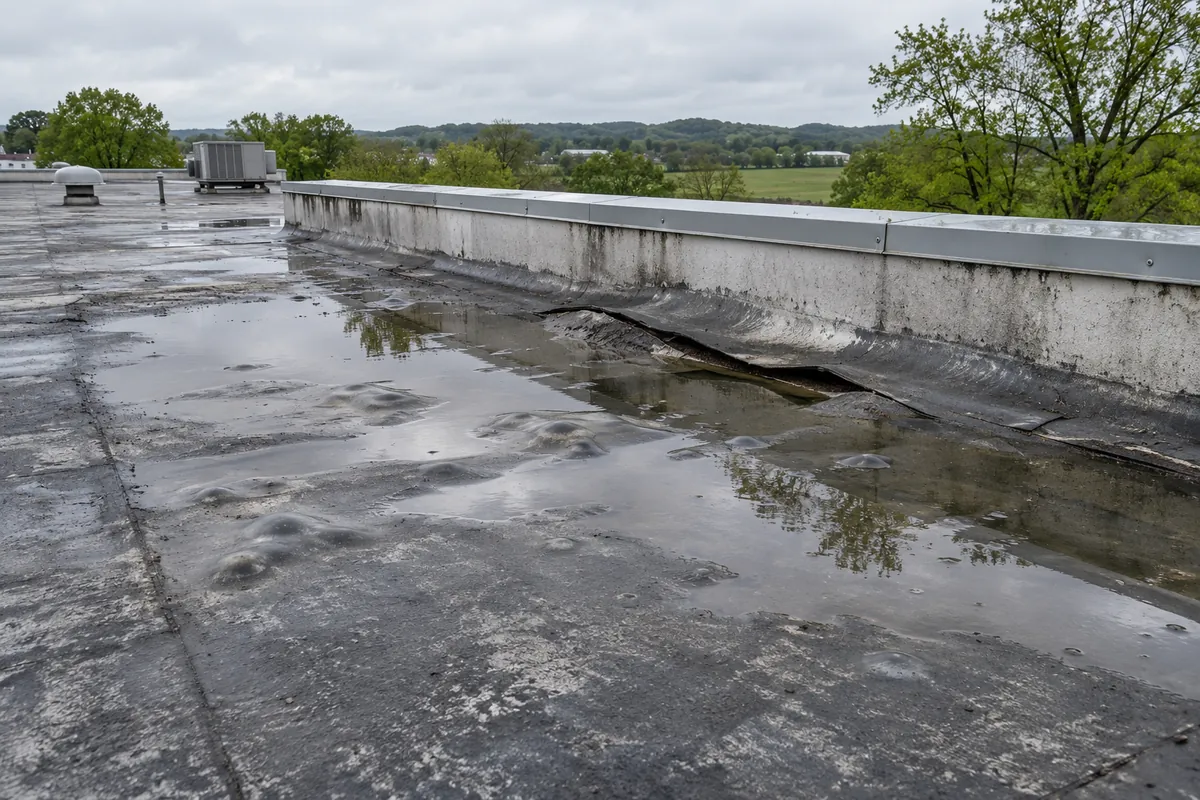
Worn commercial roof membrane and flashing that needs repair in Bowling Green
About These Answers

Start With These Commercial Roof Repair Questions in Bowling Green

These commercial roof repair questions in Bowling Green come up on warehouses, plants, churches, shops, and farm buildings across Warren County and nearby towns.

Commercial roof repair is the work of tracing leaks and fixing failed seams, torn flashing, punctures, ponding areas, and loose or rusted metal panels so an existing roof keeps the building dry. Bowling Green Commercial Roof Repair repairs flat, metal, and industrial roofs in Bowling Green, Warren County, Kentucky, and the surrounding towns.

By Roof Type

Commercial Roof Repair Questions by Roof Type Near Bowling Green

Commercial Roof Repair Basics

What does a commercial roof repair crew fix?

A commercial roof repair crew fixes the specific spots where water gets into a building, along with the damage that lets it happen. Typical repair work on warehouses, plants, churches, shops, and farm buildings:

  • Seams that have split or lifted on TPO, EPDM, and PVC roofs.
  • Flashing pulled loose at parapets, curbs, and pipe boots.
  • Punctures from dropped tools, hail, or foot traffic.
  • Backed-out screws, open end laps, and rusted panels on metal roofs.
  • Clogged or cracked drains, scuppers, and gutters.

Repair keeps the existing system in service. When damage spreads past a few areas, restoration or replacement enters the conversation.

Should a commercial roof be repaired, restored, or replaced?

Repair fits a roof with sound field material and a handful of failures, restoration fits a roof that is aging evenly but still dry underneath, and replacement fits a roof with widespread wet insulation or failed material.

PathRoof conditionWork involved
RepairIsolated leaks, a few open seams or loose fastenersPatches, reflashing, fastener swaps, drain fixes
RestoreWeathered surface, many small defects, dry insulationRepairs first, then a full-surface coating or seam treatment
ReplaceWet insulation across large areas, brittle or shrunk membrane, rust-through panelsTear-off or recover with a new system

A moisture survey sorts most roofs into one of these rows. Wet insulation is the dividing line, since coating or patching over it traps the water in place.

How does a temporary roof patch differ from a permanent repair?

A temporary repair slows water down until conditions allow proper work, while a permanent repair rebuilds the failed detail with materials that match the roof system.

Temporary repairPermanent repair
Typical useActive leak during wet or cold weatherPlanned fix once the surface is dry and clean
MaterialsRoof cement, wet-patch mastic, tarps, tapeWelded or primed patches, new flashing, new fasteners or panels
Surface prepMinimal, often on a damp surfaceCleaned, dried, primed to the system's specs
LifespanShort; meant to be replacedLasts with the surrounding roof
Follow-upRemoved and redoneInspected on the next routine visit

Mastic smeared over a TPO seam, for example, has to come off before a welded patch can bond.

Flat Roof Repair Questions

How are open seams repaired on a TPO or EPDM flat roof?

Open seams on a TPO roof are cleaned and rewelded or covered with a welded patch, while EPDM seams are cleaned, primed, and covered with seam tape or a cover strip. The method follows the membrane, so the first step is confirming which sheet is on the roof.

On TPO, weathered material has to be scrubbed with a membrane cleaner before hot air will fuse it. On EPDM, old adhesive and talc get removed until the rubber shows clean, then primer goes on.

A probe check along the rest of the seam line shows whether the failure is a single spot or a whole lap starting to let go.

Why do blisters form on a flat commercial roof, and when are they cut out?

Blisters form when moisture or air trapped between roof layers expands in the sun and lifts the membrane or felts. Built-up and modified bitumen roofs get them most, along with adhered single-ply where bonding was spotty.

Small, firm blisters with intact surfaces are usually left alone and watched. A blister that is cracked, growing, or sitting in a walk path gets cut, dried, re-adhered, and patched over. Clusters of blisters across the field point to wet insulation underneath, and a core cut or moisture scan confirms it before any repair is planned.

How is ponding water fixed on a flat roof?

Ponding is fixed by getting water to a drain, either by clearing what blocks it or by adding slope where the roof sags. Water left standing for days after rain speeds up seam and surface wear.

Repairs move from simple to involved:

  • Clear debris from drains, strainers, and scuppers.
  • Lower a drain that sits high, or add a drain sump.
  • Build crickets or tapered insulation saddles behind RTU curbs.
  • Add an overflow scupper through the parapet.
  • Check the deck under persistent ponds for deflection or rust.

Ponding in the same spot after every rain points to structure or slope, which patching alone leaves in place.

How is a puncture in a flat roof membrane repaired?

A puncture is repaired with a patch of matching membrane adhered or welded over the hole after the area is cleaned and the insulation underneath is checked for water.

Roof typePatch methodExtra check
TPOHot-air welded TPO patch with rounded cornersProbe the weld edges
EPDMPrimed area with a peel-and-stick EPDM patchRoll the patch firmly, seal edges
PVCHot-air welded PVC patchMatch PVC grade near grease vents
Modified bitumenCut-in cap sheet patch, torched or cold-appliedCheck granule coverage
Built-upLayered felts and bitumen with gravel replacedLook for wet felts around the hole

Wet insulation under a puncture gets cut out and replaced before the patch goes on.

Why do flat roofs leak at parapet walls and curbs?

Flat roofs leak at parapet walls and curbs because that is where the membrane turns vertical, and the flashing there takes the most movement and sun. Base flashing pulls away as the membrane shrinks, termination bars loosen, and caulk at the counterflashing dries out.

Parapet coping is a frequent hidden source. Open coping joints let water run down inside the wall and come out under the flashing. On RTU curbs, rusted curb caps and loose sheet metal let rain behind the curb flashing. Repairs include new base flashing, reset termination bars, new coping joint covers, and fresh sealant at counterflashing reglets.

Commercial Metal Roof Repair Questions

Why do screws back out on a metal roof, and how is that fixed?

Screws back out on a metal roof because the panels expand and contract every day, slowly working fasteners loose and widening their holes. Rubber washers under the heads also dry out and crack, which lets water run down the shank.

Repair crews walk every fastener line, snug loose screws, and replace stripped ones with a larger-diameter screw that grips fresh metal. Cracked washers get new fasteners with new washers.

Missing screws along purlin lines get replaced, because a gap in the pattern lets panels lift. Fasteners near the ridge and eave get special attention, since those rows loosen first.

Can rusted metal roof panels be patched, or do they need replacing?

Rusted metal panels can be patched when the rust is limited to small areas and the surrounding steel is still firm, and they need replacing when holes run through large parts of the sheet.

For small holes, crews wire-brush to bright metal, prime, and set a metal patch or fabric-reinforced patch over the spot.

Panels with rust-through along whole laps or at the eave get cut out and replaced with a matching profile. The new panel has to line up with existing ribs, so the profile and gauge get measured on site. Purlins under the rusted area get checked for rust or bending before the new sheet goes on.

How are leaking end laps repaired on a metal roof?

Leaking end laps are repaired by opening or cleaning the lap, replacing the sealant tape or sealant bead, and refastening the lap with new stitch screws. Water running downslope gets drawn into end laps, which makes them one of the most common metal roof leak points.

Where the lap can be opened, crews lift the upper panel, clean out the old tape, and set new butyl tape. Where it cannot, the lap gets cleaned and covered with a fabric-reinforced seam treatment. Ridge cap joints and closure strips at the same line get checked too, since they often fail together.

What goes wrong with gutters and eave trim on metal buildings?

Gutters and eave trim on metal buildings fail at seams, hangers, and the joint where the gutter meets the panel ends. Long panel runs dump large amounts of water at once, so undersized gutters overflow and spill behind the eave trim.

Common repairs:

  • Resealing gutter end caps and splice joints.
  • Replacing bent or missing hangers and straps.
  • Adding downspouts where a single outlet serves too long a run.
  • Refastening eave trim and replacing missing closures.
  • Clearing debris guards and outlets clogged with leaves.

Water stains on wall panels under the eave are a reliable sign that the gutter is backing up.

How does metal roof repair differ from membrane roof repair?

Metal roof repair centers on fasteners, laps, and rust, while membrane roof repair centers on seams, flashing, and punctures in a continuous sheet.

Repair itemMetal roofMembrane roof
Most common leakScrews, end laps, ridge capsSeams, base flashing, penetrations
Patch materialMetal patch or reinforced sealantMatching membrane, welded or taped
Surface prepWire brush, rust primerMembrane cleaner, primer for EPDM
SkylightsReplace cracked skylight panels to match the rib profileReflash skylight curbs
Structural checkPurlins and clipsDeck and insulation

Buildings with both roof types need both skill sets, especially at the wall or eave where the two meet.

Commercial Roof Leak Repair Questions

How do you find the source of a commercial roof leak?

Finding a roof leak starts inside at the stain or drip, then moves to the roof directly above and upslope from that point. Water travels along the deck, insulation, and purlins before it shows, so the entry point is often several feet away.

Tracing methods include:

  • Visual checks of seams, flashing, fasteners, and penetrations near the stain.
  • Moisture meters and core cuts to map wet insulation.
  • Infrared scans after sunset, when wet insulation holds heat longer.
  • Controlled water testing, one section at a time, with someone watching inside.

Each suspect spot gets marked and photographed before repair.

Why does a roof leak show up far from where water gets in?

A roof leak shows up far from its source because water runs along the deck flutes, purlins, or the upper face of the insulation until it finds a joint or a low spot to drop through. On a steel deck, water can follow a flute across a whole bay.

That is why a ceiling stain under the middle of a warehouse can trace back to a curb, a pipe boot, or a parapet several feet away.

Light fixtures, sprinkler pipes, and duct runs also carry water sideways. Mapping stains on a floor plan and lining them up with drains, curbs, and walls narrows the search before anyone cuts the roof.

Where do leaks start on different commercial roof types?

Leak sources follow the roof system, so the first places to check change with the roof type.

Roof typeMost frequent leak sources
TPO and PVCSeam edges, T-joints, pipe boots, curb corners
EPDMSeam tape failures, shrinkage at parapets, pipe boots
Modified bitumenLap edges, blisters, flashing at walls
Built-upSplits, blisters, gravel stop edges, pitch pans
Exposed-fastener metalScrews and washers, end laps, ridge caps
Standing seam metalEnd laps, ridge closures, curb flashing, gutters

Rooftop units sit on every roof type, and their curbs, condensate lines, and access panels add leak points of their own.

Are pitch pans a common source of roof leaks?

Pitch pans are a frequent leak source, because the filler inside them shrinks and pulls away from the pipe or support it surrounds. Water then runs down the gap and into the building.

A short-term fix is refilling the pan with fresh pourable sealer after cleaning out the old filler.

A longer-lasting fix replaces the pitch pan with a pre-formed boot, a sealed curb, or a pipe support that sits on the membrane. Clusters of conduit through one pan are the hardest to seal, and grouping them into a single curb with a cover is often the cleaner repair.

What can a building owner do during an active roof leak?

During an active leak, the safest steps are inside the building: protect equipment and stock, catch the water, and note where and when it drips. Going onto a wet roof in a storm puts people at risk.

Useful steps:

  • Move or cover inventory, electronics, and machinery under the drip.
  • Set out buckets and keep walkways dry.
  • Mark the drip location on a floor plan with the date and time.
  • Check that roof drains and scuppers visible from the ground are flowing.
  • Photograph ceiling stains as they grow.

Those notes help match the leak to a seam, curb, or drain once the roof is dry enough to inspect.

Industrial Roof Repair Questions

How is roof repair scheduled over a running plant?

Industrial roof repair is scheduled around production by working in small areas, coordinating equipment shutdowns, and planning crane or hoist lifts around shipping. Repair crews and plant maintenance agree on access routes, hot work rules, and which RTUs and exhaust fans can shut down and when.

Typical steps include a safety briefing, marked walkways from the roof hatch, protection over open production areas, and a daily check that every opened seam or flashing is closed before crews leave. Repair windows often follow shift changes or weekend downtime to keep exhaust and makeup air units running when the plant needs them.

What damage does plant exhaust do to roof membranes?

Plant exhaust deposits oils, grease, solvents, or heat on the membrane around fans and stacks, and that buildup softens, swells, or cracks the sheet over time. EPDM is especially vulnerable to oils, and TPO and PVC react differently depending on the product and the chemical.

Damage shows as soft, gummy areas, discolored rings around exhaust fans, cracked surfaces near hot stacks, and seams that open near the vent. Repair removes the damaged membrane, replaces it with a sheet rated for that exposure, and adds a grease containment box or a sacrificial walkway pad under the fan discharge.

How are worn walkway routes and traffic damage repaired?

Traffic damage on industrial roofs is repaired by patching punctures and scuffs along service routes, then adding walkway pads so the same path stops wearing through. Crushed insulation under the membrane shows as soft dips, and those spots get new insulation and cover board before patching.

Wear concentrates between the roof hatch and RTUs, around exhaust fans, and near ladders. Dropped screws and tools leave small punctures that leak slowly for months. A sweep of the roof with a magnet after each service call cuts down on that damage. Walkway pads welded or adhered along that route spread foot loads.

How are failed roof drains and overflow scuppers repaired on large roofs?

Failed roof drains are repaired by replacing cracked bowls or inserting a retrofit drain, resetting the clamping ring, and reflashing the membrane into the drain. Overflow scuppers get new sleeves and flashing where they pass through the parapet.

Large roofs depend on every drain working, so a clogged or cracked drain backs water into wide ponds. Repairs also cover missing strainers, broken clamping bolts, and drain sumps that have flattened. Overflow scuppers that sit too high to work, or that were sealed shut during an earlier repair, get reopened or reset to the right height.

How is a large industrial roof surveyed for hidden wet insulation?

A large industrial roof is surveyed for wet insulation with an infrared scan, a capacitance or impedance moisture meter grid, and core cuts that confirm the readings. Wet insulation holds heat after sunset, so an infrared camera picks up warm patches from the roof or the air.

Readings get mapped on a roof plan, and core cuts in a few suspect areas show whether the insulation is damp or soaked. The survey decides whether spot repairs, partial replacement, or full replacement fits. It also finds leaks that have not reached the ceiling yet, which keeps them from spreading under the membrane.

Question About Your Own Roof?

Tell us what you see and where.

Leaking Now

Water coming in right now? Call us and describe where it drips.

Call Us

Planning A Repair

Want a person to look at the roof? Send the address for a free estimate.

Get A Free Estimate
Local And Cost

Bowling Green Weather, Cost, and Town Questions on Commercial Roof Repair

Weather, Permits and Codes in Bowling Green

How do Bowling Green's rain and freeze-thaw cycles damage commercial roofs?

Bowling Green's frequent rain and winter freeze-thaw swings open small defects into leaks, mainly at seams, laps, and flashing. The National Weather Service's Louisville office puts the city's 1991 to 2020 yearly average near 50 inches of rain and melted snow, plus about 8.5 inches of snow and a January average of about 37 degrees.

Each cycle of overnight ice inside a seam edge or a metal lap widens the gap slightly. Ponds near curbs leave ice that stresses flashing. Gutters packed with leaves back water under eave trim. Late-fall drain cleaning and seam checks catch most of this before winter.

What should be checked on a commercial roof after high winds or a tornado?

After high winds, the roof perimeter, flashing, and anything mounted on the roof get checked first, since wind pulls at edges and loose parts. On December 11, 2021, the National Weather Service confirmed an EF-3 tornado through Bowling Green with peak winds around 165 mph and an EF-2 near the regional airport.

Storm checks cover:

  • Edge metal, coping, and gutters bent up or pulled loose.
  • Membrane lifted or billowing at corners.
  • Panels creased and ridge caps or trim missing on metal roofs.
  • RTUs shifted on their curbs, and skylights cracked by debris.
  • Punctures from flying debris across the field.

Photos with dates support any insurance claim.

How does hail damage show up on a commercial roof?

Hail damage shows up as bruises, cracks, and punctures in membranes, dents in metal panels and trim, and broken skylights and vent caps. Some damage is easy to miss from the ground, especially on single-ply roofs where a bruised spot looks normal at first.

Inspectors check soft spots on the membrane over insulation, cracked cover board under the sheet, dents along ridge caps and panel ribs, shattered skylight panels, and dented RTU fins. Dents on metal panels with intact paint are mostly cosmetic. Cracked membranes, broken skylights, and split seams need repair before the next rain finds them.

Do commercial roof repairs need a permit in Bowling Green and nearby towns?

Permit needs for roof repair depend on the scope and the local office, and the City of Bowling Green Building Division decides for buildings inside city limits. Small repairs and full reroofing are treated differently, so describe the work clearly when you call.

TownCountyOffice to call
Bowling GreenWarrenBuilding Division (city limits)
FranklinSimpsonZoning office, then state inspectors
RussellvilleLoganRussellville Building Official
ScottsvilleAllenAllen County and city local inspector
MorgantownButlerLocal inspector for Butler County
AuburnLoganAuburn city hall, Logan County offices
GlasgowBarrenGlasgow building and electrical office
Cave CityBarrenShared Barren County inspector
BrownsvilleEdmonsonEdmonson inspector; DHBC for commercial work

Repairs that replace panels, decking, or RTU curbs draw more review than patching a seam.

Cost, Value and Taxes

What sets the cost of a commercial roof repair?

The cost of a commercial roof repair depends mostly on how many problem spots there are, how hard they are to reach, and how much wet material has to come out. Other cost drivers:

  • Roof type and the patch materials it requires
  • Number of seams, curbs, and penetrations involved
  • Wet insulation or deck damage found during repair
  • Rusted panels or purlins that need replacing on metal roofs
  • Access, such as lifts, ladders, or roof height
  • Work scheduled around production or tenant hours

A single open seam near the roof hatch costs far less than reflashing a long parapet wall.

When does repeated repair stop making sense on a commercial roof?

Repeated repair stops making sense when leaks keep appearing in new places, the field membrane or panels are failing broadly, or wet insulation has spread under large areas. At that point repair spending chases symptoms while the roof keeps getting worse.

Warning signs include repair records showing the same seams or laps failing season after season, brittle membrane that cracks when folded, shrinkage pulling flashing off parapets, and rust-through on many panels. A moisture survey and a look at the repair history together show whether restoration or replacement fits better than another round of patches.

How do roof repairs and Section 179 interact?

Section 179 covers roofs as qualified improvements to existing nonresidential buildings, according to IRS Publication 946, with a 2026 limit of $2,560,000 and a phase-out once qualifying property passes $4,090,000. Ordinary repairs are often handled as business expenses instead, which is a separate tax question.

Whether a given job counts as a repair or a roof improvement depends on its size and what it replaces. Ask a CPA, and keep invoices that separate seam and flashing repairs, panel replacement, and RTU work.

Questions by Town

How does Bowling Green's karst terrain affect roof drainage repairs?

Bowling Green sits on karst, and the Kentucky Geological Survey notes that sinkhole flooding in Bowling Green and Warren County is well known and has led to strict local rules. The KGS also points out that roofs and parking lots add runoff that reaches sinkholes faster.

For roof repair, that puts attention on where roof water goes after it leaves the downspouts. Cracked downspout boots, disconnected leaders, and overflowing scuppers can dump water next to foundations or into low spots on the lot. Repairs to gutters, drains, and leaders should keep discharge flowing into the site's planned drainage.

Which utility powers a Bowling Green building, and how does that shape roof repair?

Buildings inside Bowling Green city limits get power from Bowling Green Municipal Utilities, according to TVA's local power company listing, while many rural Warren County buildings sit on Warren RECC lines. The name on the electric bill shows which applies.

That matters when a repair at an RTU curb, exhaust fan, or service mast needs equipment shut off. Reflashing a curb under a running unit is unsafe and leaves a poor seal. Knowing the utility ahead of time makes it easier to plan disconnects and coordinate with whoever maintains the meter and service drop.

Who supplies power in Franklin, and how does that affect roof repairs?

TVA's listing credits Franklin Electric Plant Board with more than 4,800 customers within the city limits, and the Warren RECC cooperative covers rural ground around town. Check the bill to see which one feeds the building.

Roof repairs around RTUs, exhaust fans, and service masts often need power shut down for a few hours. Weatherheads and service cables that pass through metal panels or membrane need their boots or pitch pans resealed, and rusted conduit straps get new fasteners. Planning the shutdown with the right provider keeps the repair on schedule.

Which power provider serves Russellville buildings, and what roof repairs involve it?

Russellville Electric Plant Board has close to 4,000 accounts in town per TVA's directory, and buildings outside the limits can sit on the Warren RECC cooperative's lines. The bill on the building settles which applies.

Roof repairs that involve the provider include reflashing a service mast through the roof, resealing conduit penetrations, and repairing curbs under units that need disconnecting. Conduit runs strapped across a metal roof leave dozens of small screw holes, and each one needs a sealed washer or sealant during repair.

What should Scottsville owners know about roof repairs on shop and farm buildings?

Many buildings in and around Scottsville run on Tri-County Electric, which names Allen County in its territory and has a district office in town. Its territory crosses into Tennessee, so confirm the provider on the bill before shutting down heaters or fans for repair.

Shop and farm buildings with exposed-fastener roofs leak first at screws, end laps, and gutter seams. Long eave runs overload small gutters in heavy rain. Repairs that replace failed washers, reseal laps, and add downspouts handle most of these leaks.

What should Morgantown owners check before calling for a metal roof repair?

Morgantown owners should look for ceiling stains, loose trim, and overflowing gutters, and confirm whether the building is on Warren RECC lines, which serve all or part of Butler County. That information speeds up the repair visit.

If the repair grows into replacing panels or decking, Butler County's local building inspector is the contact, per the state's Butler County sheet. Panel swaps, purlin repairs, and new skylight panels are the jobs most likely to need that call. Patching fasteners and laps on existing panels is smaller work.

How can Auburn owners tell a roof leak from condensation?

Condensation shows up as drips spread across a metal roof on cold mornings, while a roof leak shows up in one spot during or after rain. Shop and farm buildings with bare steel over open framing are prone to it in winter.

Leaks line up with screws, end laps, ridge caps, and skylight panels, and they follow rainfall. Condensation follows temperature and indoor humidity, and it drips even on dry days.

Repairing laps and fasteners stops leaks, while condensation needs insulation, ventilation, or a vapor retarder. Rural Logan County buildings can be on Warren RECC's system, so confirm the provider before shutting off heaters.

Does Glasgow's property maintenance code affect roof repairs?

Glasgow's Building and Electrical Inspectors Office enforces the International Property Maintenance Code, which covers the condition of building exteriors, including roofs. Open seams, missing ridge caps, loose coping, and torn flashing all fall under that kind of exterior upkeep.

The same office issues building and electrical permits for the city and Barren County, so repairs that grow into panel or deck replacement start there. Farmers RECC, headquartered in Glasgow, serves Barren County, and many buildings sit on its lines. Confirm the provider before shutting down RTUs for curb repair.

Who handles electrical work tied to a roof repair in Cave City?

Electrical inspection in Cave City goes through the city's own office, while building inspection is shared with Glasgow, Park City, and Barren County. Roof repairs that move or rewire anything mounted on the roof touch the electrical side.

Examples include relocating roof-mounted lights, resetting signs fastened through panels, and moving conduit off a curb to reflash it. The roof patch and flashing work falls under the building side. Every abandoned screw hole from removed straps or brackets gets sealed during the repair.

What roof repair issues are common on Brownsville buildings near the Green River?

Brownsville's Green River setting puts some buildings on low ground, so repair visits there look hard at the base of each wall and at every downspout outlet. Roof water that pools at the base of a wall soaks sills and rusts panel bottoms.

On the roof, repairs focus on gutters sized for the runoff, downspout extensions that carry water away, and flashing where roofs meet walls. Farmers RECC serves Edmonson County, so confirm the provider before shutting off rooftop equipment. Edmonson County's state sheet names DHBC for commercial construction permits on bigger repairs.

Which other towns near Bowling Green get roof repair service?

Roof repair service also covers these towns, where the power provider changes with location.

TownCountyProvider to confirm on the bill
Smiths GroveWarrenWarren RECC or Farmers RECC
WoodburnWarrenWarren RECC covers parts of the county
AlvatonWarrenRural service; check the meter tag
LewisburgLoganWarren RECC lines in parts of the county
AdairvilleLoganRural Logan County provider near the Tennessee line

Knowing the provider ahead of time speeds up shutdowns for curb, mast, and exhaust fan repairs.

Getting Started

What should I document when a commercial roof starts leaking?

Dates, locations, and weather for each leak make a commercial roof repair faster to trace. Helpful records:

  • Photos of ceiling stains and drips, with dates and times.
  • Floor plan copies marked with each leak spot.
  • Rainfall or wind notes for the day it leaked.
  • Past repair records, including which seams or curbs were patched.
  • RTU and roof-mounted equipment lists.

Matching that history to seams, curbs, drains, and fasteners on the roof narrows the search before anyone opens the membrane.

What happens during a commercial roof leak inspection?

A leak inspection walks the roof over and upslope from each reported leak, then checks seams, flashing, fasteners, drains, and penetrations around those spots. Inspectors probe seams, test fasteners, and look for punctures, blisters, and ponding.

Moisture readings or core cuts show whether insulation under the leak is wet. Photos tie each finding to a location on a roof plan, and each one is labeled as a repair item, a temporary fix, or a sign the area needs restoration or replacement. Bowling Green Commercial Roof Repair then walks the owner through the list.

Still Have Commercial Roof Repair Questions in Bowling Green?

Call us or send the address, and we will answer them on your own roof.

Call Us